May 22, 2023
Interview COLLECTION TWO
(ENT-)MYSTIFIZIERUNG DER MODE
ÜBER DIE DEMONSTRATION DES ICHS
(DE-)MYSTIFICATION OF FASHION
ABOUT THE DEMONSTRATION OF THE EGO
TSCHAIKOWSKI is a label founded by designer and namesake Jonathan Tschaikowski as part of his Master of Arts at the University of the Arts Bremen. For his final presentation, he developed a fashion show staged in a former cold store of an abandoned factory. At the heart of the project are questions surrounding brands, fashion codes, social belonging, and the performance of the self.

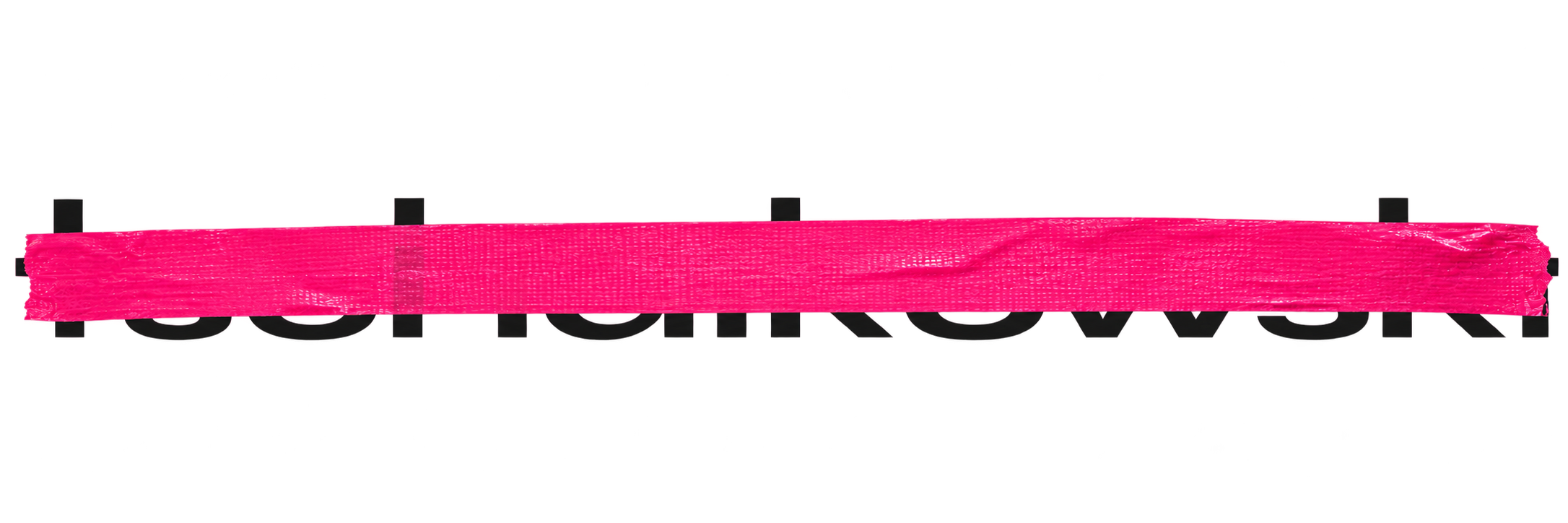
Q: First of all, everyone arriving at your show was greeted with neon-pink tape and asked to cover up the logos on their clothes. Even your own logo on the runway was taped over. What was the idea behind it?
I got the idea for the tape from a make-up artist last summer. She came up to me, covered the logo on my shirt with tape and said, “This is what they do in London now!” At first, I thought it was pretty stupid. You cover up the brand, but at the same time the neon color obviously draws attention to it.
Since then, I’ve been covering up my own logos and incorporated the tape into my concept. In a strange way, it mystifies the garment – and that is exactly what my work is about. I also liked the idea of people associating my label with tape. In fact, the day after the show, someone approached me in a restaurant. I didn’t know him; he had seen the show and said to me: “Tape can be a brand!”
Q: The tape wasn’t the only striking element. You also introduced images of two people as characters for the collection. What is the collection about?
The collection is about a clash between different social classes. The two characters, Lennar and Viljam, represent different social orders and the disparities between them. It is based on observations of my own social environment, our society and pop culture. Although our society is constantly changing through new technologies and shifting visual habits, it continues to reproduce stereotypes around status, gender, coolness and beauty.
In my own socialization, there is a strong emphasis on who you want to become – on the future, perfect version of yourself – rather than on who you actually are and where you come from.

Q: “(De-)Mystification of Fashion – About the demonstration of the ego” is the title of your work. It sounds like a complex subject. What does it mean to you?
We give clothing meaning and create an illusion through certain mechanisms and strategies. I call this process “mystification.” It is what turns clothing into “fashion.” The fashion industry no longer communicates clothing alone. It also communicates values, lifestyles and identities. Brands create immersive worlds in order to establish a connection with consumers. Clothing therefore becomes a means of expressing identity and positioning ourselves within society.
Certain codes play an important role in this. They allow us to be perceived and categorized by the people around us. These are the same codes I work with in my collection. My work is intended as a kind of gesture or signpost: we don’t have to adopt the structures we have learned and come to perceive as normative. And if we do, we can at least do so consciously.
Q: You talk about codes. Can you give an example from your collection?
For me, codes are symbolic signs or signals that can communicate certain meanings in fashion – through colors, patterns, cuts, materials or particular garments. My bag, for example, is a reference to the classic toiletry bag. It is currently very popular: because it is cheaper than a handbag, it is often repurposed as one, particularly by young men. In this way, they gain access to what was originally a luxury product. Branding obviously plays an important role in this.

Q: What would happen if you removed these mechanisms and strategies?
In my work, I assume that fashion would lose a significant part of its meaning without these mechanisms. Clothing would become more strongly reduced to its function, while its ability to express identity and social position would diminish.
Brands would also find it more difficult to communicate values or establish a connection with consumers. At the same time, the cultural and social influence of the fashion industry would become weaker.
Q: What could be an alternative?
One possibility would be to consciously move away from stereotypes and clichés and instead place individuality and diversity at the center.
Designers and brands could represent a wider range of body types, identities and styles, while questioning traditional forms of brand communication. The focus would shift more towards authenticity and individual expression. However, even brands that advocate for greater diversity still rely on conventional mechanisms and strategies. For me, the crucial difference lies in transparency.


Q: You talk about questioning traditional forms of fashion presentation, yet you yourself operate largely like a conventional fashion label. What was the purpose of your show?
That contradiction was precisely part of my work. As someone who operates within the fashion world, I see myself in different roles: as a consumer, fashion photographer and fashion designer. I experience a duality between creative expression and the reality of the capitalist system.
I therefore didn’t want to simply criticize the mechanisms of fashion from the outside. I wanted to use them myself and make them visible in the process.
My work is a critical reflection on the fashion world, its presentation, its accessibility and its influence on society. I’m not trying to reinvent the world. I want to show that changes within the existing system can change the way we engage with “fashion.”


A track was produced specifically for the fashion show, functioning like a DJ set and accompanying the collection throughout the entire presentation. At the after-show party, a DJ performed and there was also a live performance.
Q: Why was it important for you to have your own track for the show?
I wanted to create a moment that could stand on its own, express me and my work, and be unique. From the beginning, my idea was to operate like a conventional fashion label and investigate what was necessary to achieve that.
That was obviously quite ambitious for a one-person project. I wouldn’t have managed it within such a short period without the support of my friends and people around me. It was probably too much for a final project – but for me, it worked.
I wanted to create a collection that lasted longer than two minutes. If you understand a show as an overall experience, music and professional lighting are part of it for me. The lighting was actually planned differently as well, but due to technical difficulties, we had to change the concept at the very last minute.
If I had used existing music, that would have introduced another reference into the work. That didn’t fit my concept. At the same time, I’m incredibly lucky to have very creatively talented people around me. One thing led to another.
Produced by Luca Diebold, written and performed by Hanna Milo and Malik Ackah-Mensah. Musical support on site Jashy, DJ Simon and Sahra4K.
Q: You’ve said that you couldn’t have realized your vision without the support of your friends and people around you. You even dedicated the collection to a friend. Why?
I’m generally not a fan of singling out individual people who have supported me. Every kind of help is equally important to me, and I don’t think you can weigh one against another. That’s why I told all my friends that they should only help me if they genuinely wanted to and had the time to do so. I didn’t want to create any pressure or dependency.
Nevertheless, I have to acknowledge that without the help of one particular friend, I would have lost my way during the process of developing the 33 looks and probably wouldn’t have made it to the end. That’s why I dedicated the collection to her.
At this point, I also want to thank everyone who supported me and accompanied me throughout the process.


May 22, 2023
Interview COLLECTION TWO
(ENT-)MYSTIFIZIERUNG DER MODE
ÜBER DIE DEMONSTRATION DES ICHS
(DE-)MYSTIFICATION OF FASHION
ABOUT THE DEMONSTRATION OF THE EGO
TSCHAIKOWSKI is a label founded by designer and namesake Jonathan Tschaikowski as part of his Master of Arts at the University of the Arts Bremen. For his final presentation, he developed a fashion show staged in a former cold store of an abandoned factory. At the heart of the project are questions surrounding brands, fashion codes, social belonging, and the performance of the self.
Q: First of all, everyone arriving at your show was greeted with neon-pink tape and asked to cover up the logos on their clothes. Even your own logo on the runway was taped over. What was the idea behind it?
I got the idea for the tape from a make-up artist last summer. She came up to me, covered the logo on my shirt with tape and said, “This is what they do in London now!” At first, I thought it was pretty stupid. You cover up the brand, but at the same time the neon color obviously draws attention to it.
Since then, I’ve been covering up my own logos and incorporated the tape into my concept. In a strange way, it mystifies the garment – and that is exactly what my work is about. I also liked the idea of people associating my label with tape. In fact, the day after the show, someone approached me in a restaurant. I didn’t know him; he had seen the show and said to me: “Tape can be a brand!”
Q: The tape wasn’t the only striking element. You also introduced images of two people as characters for the collection. What is the collection about?
The collection is about a clash between different social classes. The two characters, Lennar and Viljam, represent different social orders and the disparities between them. It is based on observations of my own social environment, our society and pop culture. Although our society is constantly changing through new technologies and shifting visual habits, it continues to reproduce stereotypes around status, gender, coolness and beauty.
In my own socialization, there is a strong emphasis on who you want to become – on the future, perfect version of yourself – rather than on who you actually are and where you come from.
Q: “(De-)Mystification of Fashion – About the demonstration of the ego” is the title of your work. It sounds like a complex subject. What does it mean to you?
We give clothing meaning and create an illusion through certain mechanisms and strategies. I call this process “mystification.” It is what turns clothing into “fashion.” The fashion industry no longer communicates clothing alone. It also communicates values, lifestyles and identities. Brands create immersive worlds in order to establish a connection with consumers. Clothing therefore becomes a means of expressing identity and positioning ourselves within society.
Certain codes play an important role in this. They allow us to be perceived and categorized by the people around us. These are the same codes I work with in my collection. My work is intended as a kind of gesture or signpost: we don’t have to adopt the structures we have learned and come to perceive as normative. And if we do, we can at least do so consciously.
Q: You talk about codes. Can you give an example from your collection?
For me, codes are symbolic signs or signals that can communicate certain meanings in fashion – through colors, patterns, cuts, materials or particular garments. My bag, for example, is a reference to the classic toiletry bag. It is currently very popular: because it is cheaper than a handbag, it is often repurposed as one, particularly by young men. In this way, they gain access to what was originally a luxury product. Branding obviously plays an important role in this.
Q: What would happen if you removed these mechanisms and strategies?
In my work, I assume that fashion would lose a significant part of its meaning without these mechanisms. Clothing would become more strongly reduced to its function, while its ability to express identity and social position would diminish.
Brands would also find it more difficult to communicate values or establish a connection with consumers. At the same time, the cultural and social influence of the fashion industry would become weaker.
Q: What could be an alternative?
One possibility would be to consciously move away from stereotypes and clichés and instead place individuality and diversity at the center.
Designers and brands could represent a wider range of body types, identities and styles, while questioning traditional forms of brand communication. The focus would shift more towards authenticity and individual expression. However, even brands that advocate for greater diversity still rely on conventional mechanisms and strategies. For me, the crucial difference lies in transparency.
Q: You talk about questioning traditional forms of fashion presentation, yet you yourself operate largely like a conventional fashion label. What was the purpose of your show?
That contradiction was precisely part of my work. As someone who operates within the fashion world, I see myself in different roles: as a consumer, fashion photographer and fashion designer. I experience a duality between creative expression and the reality of the capitalist system.
I therefore didn’t want to simply criticize the mechanisms of fashion from the outside. I wanted to use them myself and make them visible in the process.
My work is a critical reflection on the fashion world, its presentation, its accessibility and its influence on society. I’m not trying to reinvent the world. I want to show that changes within the existing system can change the way we engage with “fashion.”
A track was produced specifically for the fashion show, functioning like a DJ set and accompanying the collection throughout the entire presentation. At the after-show party, a DJ performed and there was also a live performance.
Q: Why was it important for you to have your own track for the show?
I wanted to create a moment that could stand on its own, express me and my work, and be unique. From the beginning, my idea was to operate like a conventional fashion label and investigate what was necessary to achieve that.
That was obviously quite ambitious for a one-person project. I wouldn’t have managed it within such a short period without the support of my friends and people around me. It was probably too much for a final project – but for me, it worked.
I wanted to create a collection that lasted longer than two minutes. If you understand a show as an overall experience, music and professional lighting are part of it for me. The lighting was actually planned differently as well, but due to technical difficulties, we had to change the concept at the very last minute.
If I had used existing music, that would have introduced another reference into the work. That didn’t fit my concept. At the same time, I’m incredibly lucky to have very creatively talented people around me. One thing led to another.
Q: You’ve said that you couldn’t have realized your vision without the support of your friends and people around you. You even dedicated the collection to a friend. Why?
I’m generally not a fan of singling out individual people who have supported me. Every kind of help is equally important to me, and I don’t think you can weigh one against another. That’s why I told all my friends that they should only help me if they genuinely wanted to and had the time to do so. I didn’t want to create any pressure or dependency.
Nevertheless, I have to acknowledge that without the help of one particular friend, I would have lost my way during the process of developing the 33 looks and probably wouldn’t have made it to the end. That’s why I dedicated the collection to her.
At this point, I also want to thank everyone who supported me and accompanied me throughout the process.